Sonodex
A fast index for sound libraries: search by words and by how things actually sound
// The problem
Sound libraries sprawl. Years of bundles and purchased packs add up to hundreds of thousands of files, named however each publisher felt like, spread across drives and network shares and often still zipped.
Finding the right sample for a game or project usually means guessing folder names, scrolling and auditioning files one at a time. The perfect door slam might be sitting in a pack you forgot you owned, under a name you would never search for.
Sonodex makes that fast. It listens to every file once, so you can search by what a sound is called and by how it actually sounds, see related sounds side by side, and get from "I need something like this" to the right file in seconds.
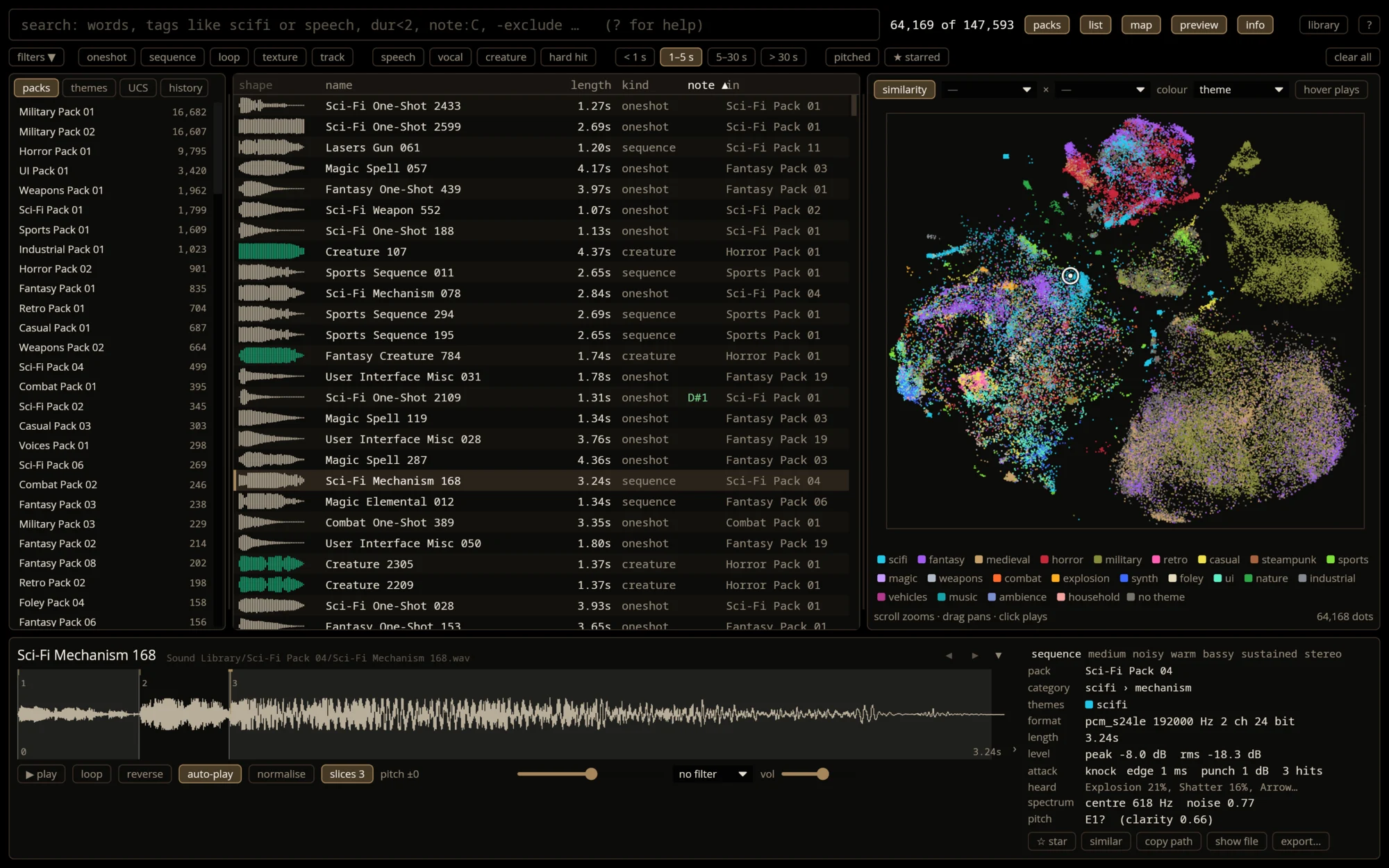
Point Sonodex at your sound libraries (local disks, network shares, even packs still inside their zip files) and it measures every sound. Then search by name and by how things actually sound, see the whole library as a map, and audition with pitch, filter and crop applied.
- 136,000
- sounds analysed in about 100 s on a 16-core desktop
- 0.3 s
- to rescan a library where nothing changed
- 101
- measurements per sound for "sounds like this"
// Features
01
Measures every sound
One streaming pass per file in constant memory: level, envelope, transients, spectrum, pitch, tempo and stereo width. From those come a kind (one-shot, loop, texture…) and descriptive tags like punchy, dark, bright or wide.
02
Knows what it is hearing
A small pretrained tagging network, built in and run on the CPU, scores every sound for speech, other human voices and creatures, and suggests sound classes. No download, no GPU, and nothing leaves the machine.
03
Search by words and by sound
Words match names, folders, packs and metadata. Everything else is a filter: length, kind, brightness, tempo, pitch, transient type, theme or voice. Or start from one sound and find the ones that measure most like it.
04
The whole library as a map
Every result becomes a dot on a similarity map, where sounds that measure alike sit together. Or pick what goes on each axis and the colour: brightness, length, attack, pitch, loudness, theme or voice.
05
Audition, slice and export
Live pitch, filter, loop and reverse while it plays. Sounds with several hits are sliced at their transients automatically, and "export as played" writes exactly what you heard as a 24-bit WAV.
06
Built for AI agents too
Every command has JSON output, and an MCP server lets AI agents search the library. Agents can propose a shortlist of sounds with their reasons; you approve or reject them in the app and the verdicts go back.
07
Shares and zips, handled
Index folders, network shares and zip archives in place. Unchanged archives are skipped on rescans, duplicates are shown once, and the library stays usable while a scan is still filling it.
// The query language
metal door slam dur<2 // words + a length limitkind:oneshot tag:punchy bright>3k // short bright hitskind:loop bpm:118..122 // loops around 120 BPMvoice:creature roar sort:-dur // creature roars, longest firsttransient:hard punch>15 -voice:any // hard, prominent attackstheme:scifi,weapons -theme:ui // sci-fi weapons, no UI sounds// Build your own
Sonodex isn't open source, but it's a very quick project to put together with agentic coding. If you want to build something like it, this is the prompt to get started with.
Build a fast cross-platform (Windows/macOS/Linux) desktop tool to index and
search large sound/music libraries for game and media work. Rust workspace:

- core (library): scan folders, SMB shares and zips (read entries in place,
  skip duplicates by checksum); decode with symphonia; analyse every file in
  parallel on all cores; store in one SQLite file (WAL + FTS5). Rescans read
  only changed files. Keep "measured" (needs audio) apart from "derived"
  (rules over names + measurements) so rules can be re-run in seconds
  without re-reading audio.
- Per sound: length, levels, attack/transients (class + slice points),
  spectrum, pitch/note, tempo, kind (oneshot/sequence/loop/texture/track),
  a feature vector, a 2D similarity layout (map position), voice
  (speech/vocal/creature via YAMNet in pure-Rust ONNX, overruled when the
  file name clearly names a non-voice thing), themes from file/folder names
  (scifi, medieval, ui… several per sound), UCS category from names.
- cli: add/scan/search/info/similar/export, JSON output, a small query
  language (words, tags, dur<2, note:C, theme:x, -exclude).
- MCP server over stdio exposing the same search, plus a review loop: the
  agent proposes a list of sounds with a note each; the user judges them in
  the app (approve/reject, notes per sound and per list); the agent reads
  the verdicts back. Reviews are rows in the same SQLite file.
- app (iced): search bar + filter chips, virtualised list with waveform
  thumbnails, a GPU point-cloud map of the whole library (colour by
  voice/theme/kind, filters apply to list and map alike), preview with
  waveform, slices, pitch/filter/loop/reverse, export; collapsible,
  resizable panels; history; one tab per pending review.

Rules: must stay fast at 150k+ sounds (search under 100 ms, full local
analysis in minutes). No cloud, no account. Test the app headlessly
with screenshots, against a copy of the index, never the real one. Ship in
milestones: core + CLI first, then the app, then MCP, then tagging.